Claude Code Memory System — AutoDream Memory Consolidation
Claude "dreams" -- silently reviewing recent sessions in the background to consolidate, update, and prune memories, much like the human brain organizes memories during sleep.
AutoDream · Trigger Conditions · Consolidation Process · Security · UI · Configuration · Comparison · Source Code
1. What Is AutoDream?
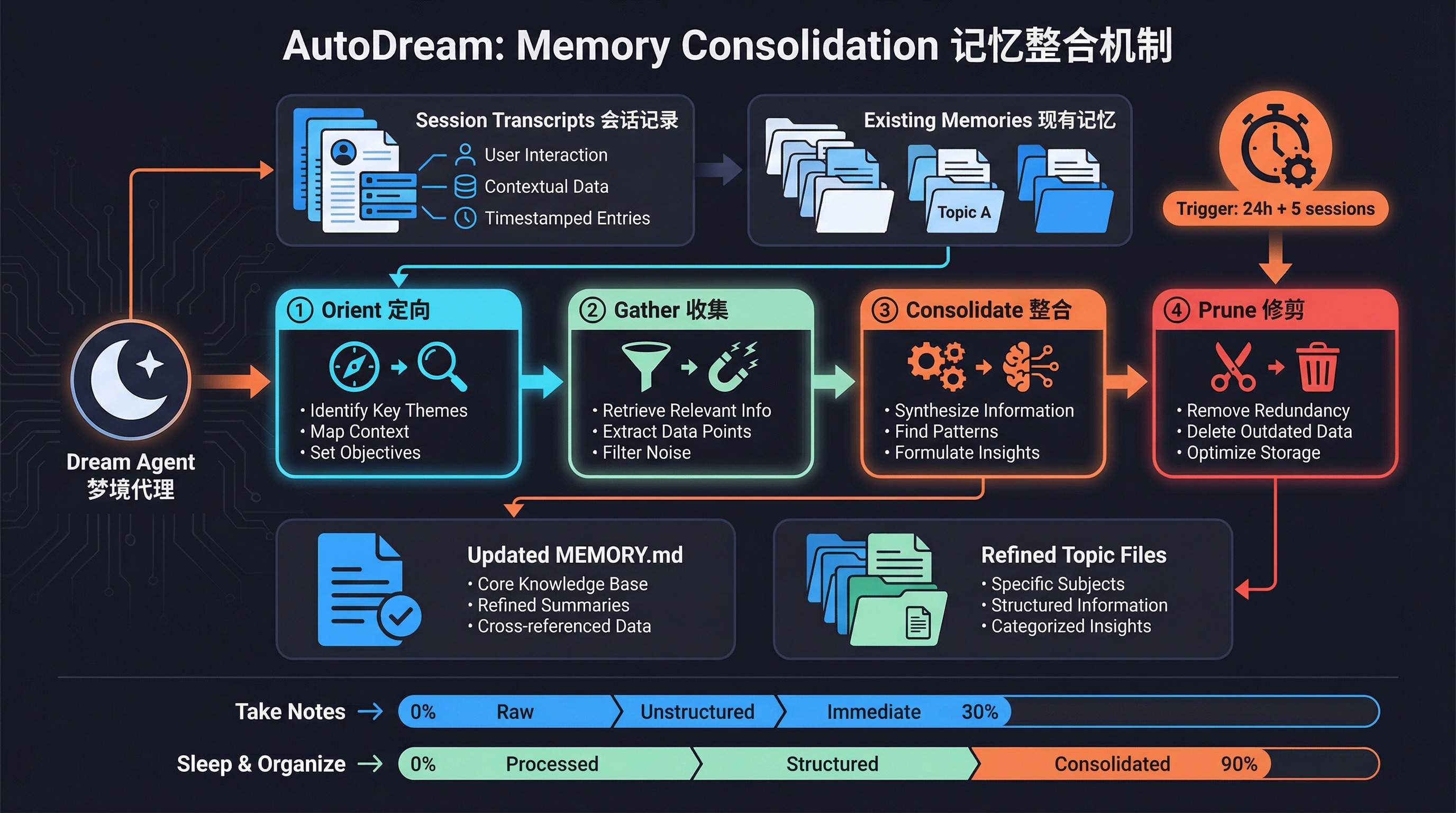
AutoDream is Claude Code's background memory consolidation mechanism, internally codenamed "Dream: Memory Consolidation".
Core metaphor:
| Human | Claude Code |
|---|---|
| Jotting down notes throughout the day | extractMemories -- extracts new memories after each conversation |
| Organizing the notebook while sleeping | autoDream -- periodically reviews multiple sessions to consolidate all memories |
When you're inactive (default interval: 24 hours with 5 accumulated sessions), Claude silently launches a "dreaming" sub-agent (forked subagent) in the background. It reviews all recent session transcripts and consolidates scattered memories into structured, deduplicated, up-to-date persistent knowledge.
Key source: src/services/autoDream/autoDream.ts
// Background memory consolidation. Fires the /dream prompt as a forked
// subagent when time-gate passes AND enough sessions have accumulated.
2. Trigger Conditions
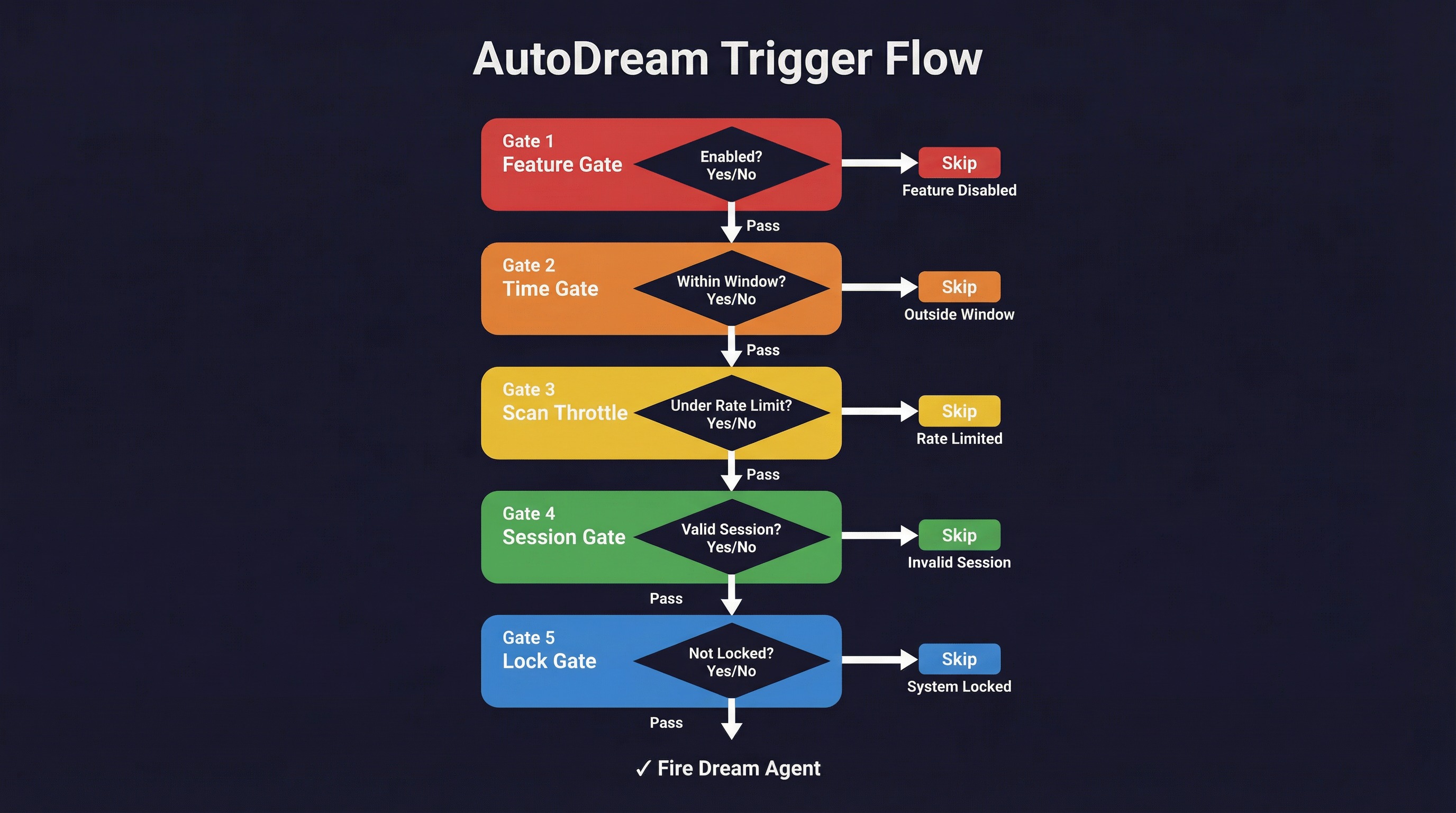
AutoDream uses a five-gate mechanism, checking in order of increasing cost:
Gate Chain
| # | Gate | Description | Cost |
|---|---|---|---|
| 1 | Feature toggle | isAutoDreamEnabled() + not KAIROS + not remote mode + autoMemory enabled | Memory read |
| 2 | Time gate | At least minHours since last consolidation (default 24h) | 1 stat call |
| 3 | Scan throttle | At least 10 minutes since last scan before rescanning | Timestamp comparison |
| 4 | Session gate | At least minSessions new sessions since last consolidation (default 5, excluding current) | Directory scan |
| 5 | Lock gate | No other process currently dreaming (PID lock file) | stat + read |
Key source src/services/autoDream/autoDream.ts:63-66:
const DEFAULTS: AutoDreamConfig = {
  minHours: 24,      // At least 24 hours since last consolidation
  minSessions: 5,    // At least 5 sessions accumulated in the interim
}
Scan Throttle
When the time gate passes but the session gate doesn't, the lock file's mtime remains unchanged, causing the time gate to pass on every subsequent turn. To avoid frequent directory scans, a 10-minute scan throttle is in place:
const SESSION_SCAN_INTERVAL_MS = 10 * 60 * 1000Execution Entry Point
AutoDream is triggered during the stop hook phase after each AI response (fire-and-forget, does not block the main thread):
Key source src/query/stopHooks.ts:154-156:
if (!toolUseContext.agentId) {
  void executeAutoDream(stopHookContext, toolUseContext.appendSystemMessage)
}
Blocking Conditions
AutoDream will not trigger in the following situations:
- KAIROS mode: Uses a separate disk-skill dream
- Remote mode:
getIsRemoteMode() === true - autoMemory not enabled
--bare/ SIMPLE mode- Inside a sub-agent: Only the main agent triggers it
3. Four-Phase Consolidation Process
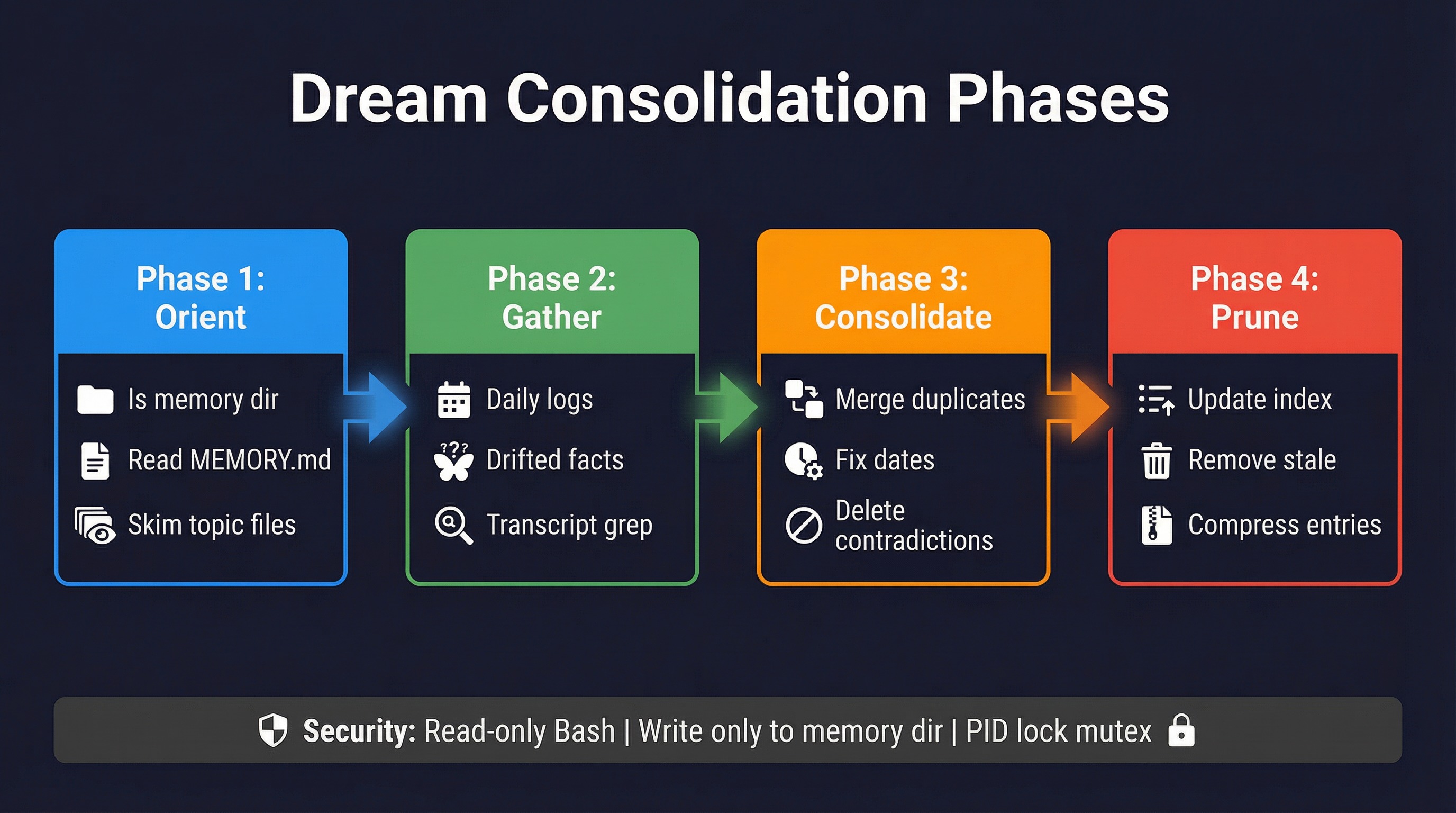
Once all gates pass, AutoDream launches a forked sub-agent that operates according to the 4-phase prompt defined in consolidationPrompt.ts:
Phase 1 -- Orient
- ls the memory directory, see existing files
- Read MEMORY.md index, understand the current knowledge structure
- Browse existing topic files to avoid creating duplicates
- If logs/ or sessions/ subdirectories exist, check recent entries
Phase 2 -- Gather Recent Signal
Collects information in order of priority (highest first):
- Daily logs --
logs/YYYY/MM/YYYY-MM-DD.md(append-stream logs) - Drifted memories -- Old facts that contradict the current codebase state
- Session transcript search -- Narrow-scope
grepsearches in JSONL transcript files
Don't exhaustively read transcript files. Only look for content you already suspect is important.Phase 3 -- Consolidate
- Merge new signals into existing topic files (rather than creating new near-duplicate files)
- Convert relative dates to absolute dates ("yesterday" -> "2026-04-03")
- Delete old facts that have been superseded
Phase 4 -- Prune and Index
- Update
MEMORY.md, keeping it within the line limit and <= 25KB - Remove pointers to outdated memories
- Compress verbose entries (index lines >200 characters have their content moved into topic files)
- Add pointers to important memories
- Resolve conflicts (when two files disagree, fix the incorrect one)
Key source: src/services/autoDream/consolidationPrompt.ts:10-64
4. Security Restrictions
The AutoDream sub-agent operates under strict tool permission constraints:
Bash: Read-Only Only
Allowed: ls, find, grep, cat, stat, wc, head, tail
Denied: All write, redirect, or state-modifying commands
File Operations: Memory Directory Only
createAutoMemCanUseTool() is the permission function shared by both extractMemories and autoDream:
Allowed: Read / Grep / Glob -- unrestricted
Allowed: Edit / Write -- only within the auto-memory directory
Denied: MCP / Agent / non-read-only Bash / other write operations
Key source: src/services/extractMemories/extractMemories.ts:167-171
Lock File Mechanism
Uses a .consolidate-lock file for process-level mutual exclusion:
| Mechanism | Description |
|---|---|
| Lock content | PID of the holder |
| Timestamp | Lock file mtime = time of last consolidation |
| Expiry | Held for more than 1 hour is considered expired (prevents PID reuse issues) |
| Contention | Two processes write simultaneously -> last writer wins, loser exits on re-read |
| Rollback | On failure, mtime is rolled back to the pre-acquisition value so the next attempt is unaffected |
| Crash recovery | Stale mtime + dead PID -> next process reclaims the lock |
Key source: src/services/autoDream/consolidationLock.ts
5. UI Presentation
Bottom Status Bar
When AutoDream is running, the bottom status bar displays a "dreaming" label:
// src/tasks/pillLabel.ts:61-62
case 'dream':
  return 'dreaming'
Task Detail Dialog
Users can press Shift+Down to open the background task dialog and view real-time dream progress:
DreamDetailDialog component displays:
- Number of sessions being reviewed
- Current phase:
starting(analyzing) ->updating(modifying memory files) - Latest assistant text response and tool call count
- List of file paths touched
Users can press
xto terminate an ongoing dream (triggers abort + lock rollback)
Completion Notification
After the dream completes, if files were modified, an inline notification appears in the main session:
appendSystemMessage({
  ...createMemorySavedMessage(dreamState.filesTouched),
  verb: 'Improved',
})
Key source:
src/tasks/DreamTask/DreamTask.ts-- Task state managementsrc/components/tasks/DreamDetailDialog.tsx-- UI component
6. Configuration and Toggles
settings.json
{
  "autoDreamEnabled": true
}- When explicitly set: Uses the user's value directly
- When not set: Controlled by the remote GrowthBook feature flag
tengu_onyx_plover
Key source src/services/autoDream/config.ts:13-21:
export function isAutoDreamEnabled(): boolean {
  const setting = getInitialSettings().autoDreamEnabled
  if (setting !== undefined) return setting
  const gb = getFeatureValue_CACHED_MAY_BE_STALE<{ enabled?: unknown } | null>(
    'tengu_onyx_plover', null,
  )
  return gb?.enabled === true
}
Remote Configuration Parameters
The tengu_onyx_plover feature flag can configure:
| Parameter | Type | Default | Description |
|---|---|---|---|
enabled | boolean | -- | Master feature toggle |
minHours | number | 24 | Minimum interval (hours) |
minSessions | number | 5 | Minimum session count |
Manual Trigger: /dream
In addition to automatic triggering, users can manually trigger memory consolidation via the /dream command. Manual triggers call recordConsolidation() to update the lock file timestamp.
7. Relationship with extractMemories
| Dimension | extractMemories | autoDream |
|---|---|---|
| Trigger frequency | After each conversation turn | Every 24h + 5 sessions |
| Trigger location | stopHooks.ts L149 | stopHooks.ts L155 |
| Processing scope | Recent messages from the current conversation | Historical transcripts from multiple sessions |
| Goal | Extract new memories | Consolidate/deduplicate/prune existing memories |
| Human analogy | Jotting down notes during the day | Organizing the notebook while sleeping |
| Shared component | createAutoMemCanUseTool | createAutoMemCanUseTool |
| Forked agent | Max 5 turns | No turn limit |
| Transcript | Not recorded (skipTranscript) | Not recorded (skipTranscript) |
Collaboration Flow
After each conversation turn
    |
extractMemories -> Extract new memory fragments -> Write *.md + MEMORY.md
    |
(After accumulating 24h + 5 sessions)
    |
autoDream -> Review all memories + session transcripts
    |
Merge duplicates / Fix stale data / Delete conflicts / Compress index
    |
MEMORY.md and topic files refreshed
8. Source Code Navigation
| File | Responsibility |
|---|---|
src/services/autoDream/autoDream.ts | Main logic: gate checks, launch forked agent, progress monitoring |
src/services/autoDream/config.ts | Toggle control: settings.json or GrowthBook |
src/services/autoDream/consolidationPrompt.ts | Dream prompt: 4-phase consolidation workflow |
src/services/autoDream/consolidationLock.ts | Lock file mechanism: concurrency prevention, timestamps, rollback |
src/tasks/DreamTask/DreamTask.ts | UI task registration: state management, termination, rollback |
src/tasks/pillLabel.ts | Bottom status bar label: "dreaming" |
src/components/tasks/DreamDetailDialog.tsx | Dream detail dialog UI |
src/query/stopHooks.ts | Execution entry point: triggers after each response |
src/utils/backgroundHousekeeping.ts | Initialization entry point: initAutoDream() |
src/services/extractMemories/extractMemories.ts | Shared createAutoMemCanUseTool |
9. Analytics Events
AutoDream records its operational state through the following events:
| Event | Timing | Attached Data |
|---|---|---|
tengu_auto_dream_fired | Dream started | hours_since, sessions_since |
tengu_auto_dream_completed | Dream completed | cache_read, cache_created, output, sessions_reviewed |
tengu_auto_dream_failed | Dream failed | -- |