Channel 系统架构解析
从源码视角深度剖析 Claude Code 如何通过 IM 平台远程控制 Agent
概念 · 架构 · 协议 · 访问控制 · 权限中继 · UI · 插件 · 安全 · CLI · 特性开关
一、什么是 Channel
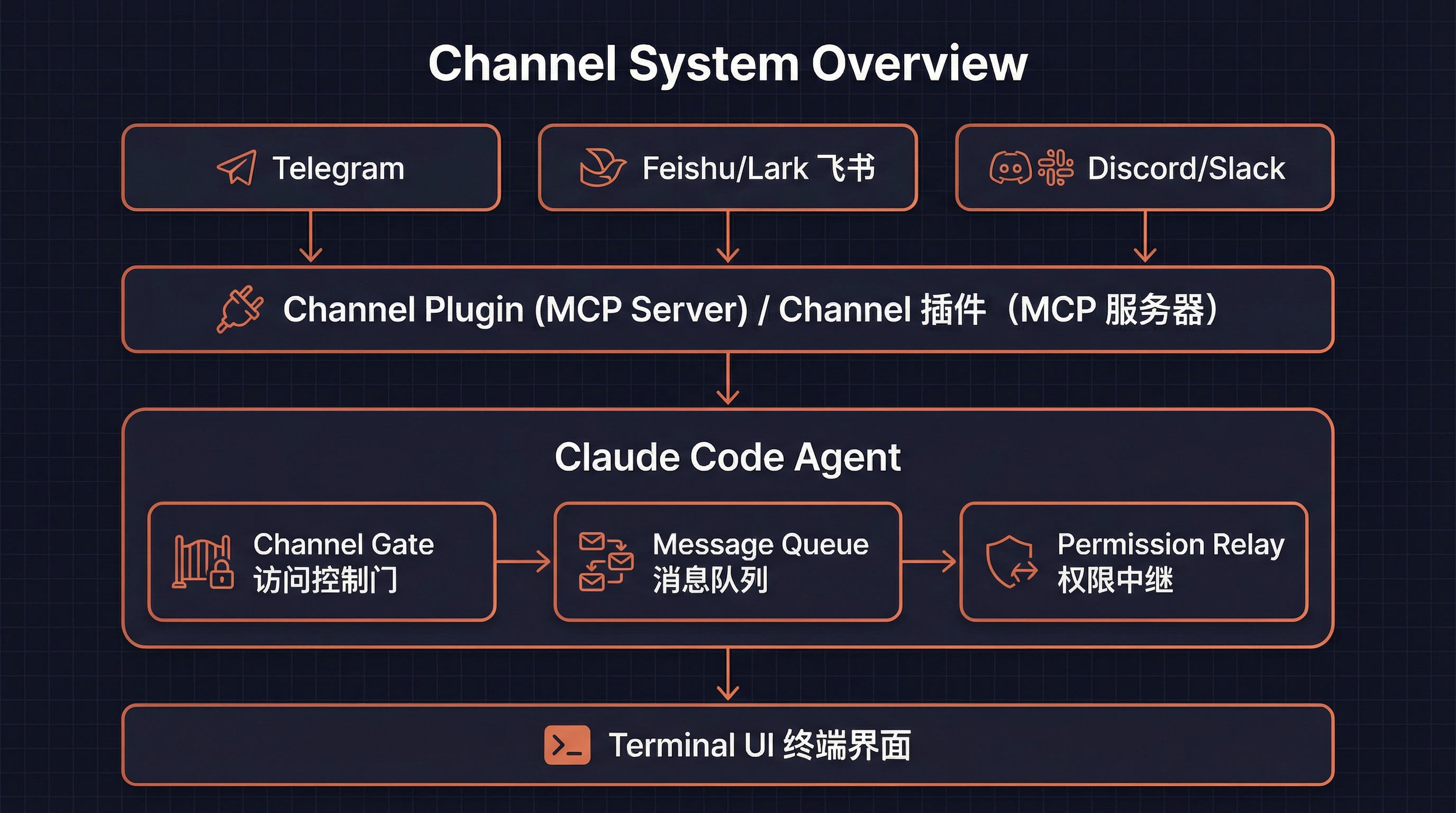
Channel 是 Claude Code 的 IM 集成系统,它允许用户通过 Telegram、Feishu(飞书)、Discord、Slack 等即时通讯平台远程控制正在运行的 Claude Code Agent。
核心理念
传统的 AI 编程助手只能在终端中交互。Channel 系统打破了这一限制——你可以在手机上通过 Telegram 给 Claude Code 发消息,它会像在终端中一样理解并执行你的请求,并将结果回复到你的聊天窗口。
Channel 的本质
从技术角度看,一个 Channel 就是一个特殊的 MCP(Model Context Protocol)Server,它需要:
- 声明能力:在 MCP 握手时声明
experimental['claude/channel']能力 - 推送消息:通过
notifications/claude/channel通知将 IM 消息推入 Agent 对话 - 暴露工具:提供
reply、react、edit_message等 MCP 工具,让 Agent 回复到 IM 平台
// Channel 的两种形态
type ChannelEntry =
  | { kind: 'plugin'; name: string; marketplace: string; dev?: boolean }
  | { kind: 'server'; name: string; dev?: boolean }
plugin 类型:来自 marketplace 的验证插件(如 plugin:telegram@anthropic) server 类型:直接指定的 MCP 服务器名称(始终需要 dev 旁路)
二、整体架构
消息流转全链路
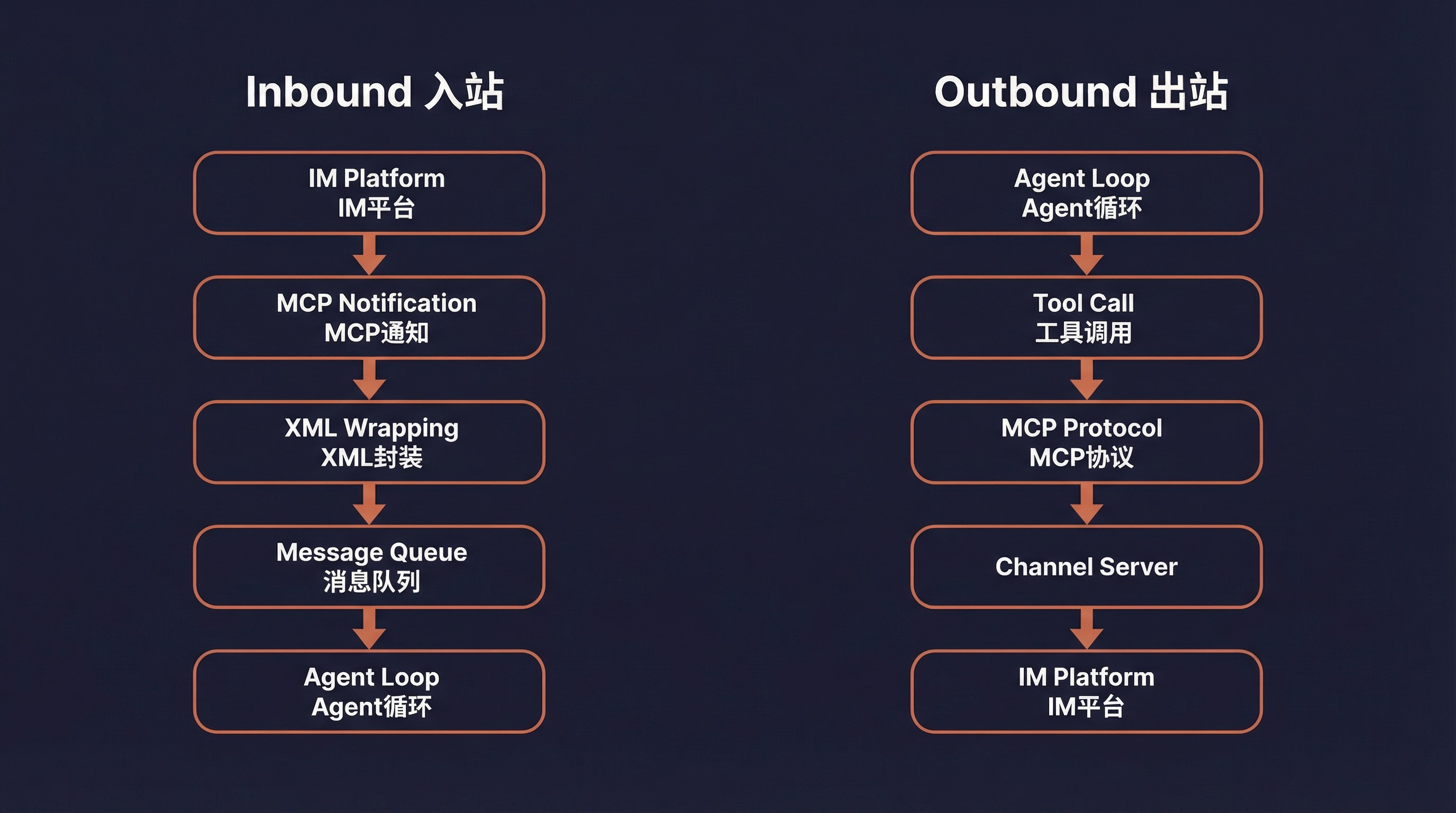
Channel 系统的消息流转遵循一个清晰的双向路径:
┌─────────────────────────────────────────────────────────────┐
│                    入站(IM → Agent)                        │
│                                                             │
│  Telegram/Feishu/Discord                                    │
│       ↓                                                     │
│  Channel Plugin(MCP Server)                               │
│       ↓                                                     │
│  notifications/claude/channel { content, meta }             │
│       ↓                                                     │
│  useManageMCPConnections → registerNotificationHandler      │
│       ↓                                                     │
│  wrapChannelMessage() → <channel source="..." user="...">  │
│       ↓                                                     │
│  enqueue({ priority: 'next', isMeta: true })                │
│       ↓                                                     │
│  SleepTool 每 ~1s 轮询 hasCommandsInQueue()                │
│       ↓                                                     │
│  Model 看到 <channel> 标签,理解消息来源                      │
└─────────────────────────────────────────────────────────────┘

┌─────────────────────────────────────────────────────────────┐
│                    出站(Agent → IM)                        │
│                                                             │
│  Model 决定使用哪个工具回复                                   │
│       ↓                                                     │
│  callTool() → Channel 的 MCP 工具                           │
│  (reply / react / edit_message / download_attachment)      │
│       ↓                                                     │
│  MCP 协议调用 Channel Server                                │
│       ↓                                                     │
│  Channel Server 发送消息到 IM 平台                           │
│       ↓                                                     │
│  Telegram/Feishu/Discord 用户收到回复                        │
└─────────────────────────────────────────────────────────────┘
核心组件关系
| 组件 | 文件 | 职责 |
|---|---|---|
| Channel Gate | channelNotification.ts | 六层访问控制门 |
| Message Wrapper | channelNotification.ts | XML 消息封装 |
| Permission Relay | channelPermissions.ts | 远程权限审批 |
| Allowlist | channelAllowlist.ts | GrowthBook 白名单管理 |
| MCP Connection | useManageMCPConnections.ts | 连接管理与通知注册 |
| Channel Message UI | UserChannelMessage.tsx | 终端渲染 Channel 消息 |
| Dev Dialog | DevChannelsDialog.tsx | 开发模式确认对话框 |
| Channels Notice | ChannelsNotice.tsx | 启动时 Channel 状态通知 |
| Plugin Integration | mcpPluginIntegration.ts | 插件作用域命名 |
| State | bootstrap/state.ts | 全局 Channel 白名单状态 |
三、消息协议
3.1 入站通知 Schema
Channel Server 推送到 Claude Code 的通知格式:
// channelNotification.ts
const ChannelMessageNotificationSchema = z.object({
  method: z.literal('notifications/claude/channel'),
  params: z.object({
    content: z.string(),
    // 透传元数据 — thread_id、user 等
    // 渲染为 <channel> 标签的属性
    meta: z.record(z.string(), z.string()).optional(),
  }),
})
3.2 XML 封装
收到通知后,系统将其封装为 <channel> XML 标签:
// channelNotification.ts:106-116
function wrapChannelMessage(
  serverName: string,
  content: string,
  meta?: Record<string, string>,
): string {
  const attrs = Object.entries(meta ?? {})
    .filter(([k]) => SAFE_META_KEY.test(k))  // 防 XML 注入
    .map(([k, v]) => ` ${k}="${escapeXmlAttr(v)}"`)
    .join('')
  return `<channel source="${escapeXmlAttr(serverName)}"${attrs}>
${content}
</channel>`
}封装结果示例:
<channel source="plugin:telegram:tg" user="alice" chat_id="123456">
帮我看看 main.ts 有什么问题
</channel>
Model 看到这个标签后,就知道消息来自 Telegram 的用户 alice,并会使用 Telegram 的 reply 工具回复。
3.3 安全的元数据过滤
Meta 键名会成为 XML 属性名,恶意构造的键(如 x="" injected="y)可能导致 XML 注入。系统使用严格的正则过滤:
// 只允许纯标识符格式的键名
const SAFE_META_KEY = /^[a-zA-Z_][a-zA-Z0-9_]*$/
实际场景中,Channel 服务器只发送 chat_id、user、thread_ts、message_id 这类安全键名。
3.4 消息入队
封装后的消息通过 enqueue 推入消息队列:
enqueue({
  mode: 'prompt',
  value: wrapChannelMessage(serverName, content, meta),
  priority: 'next',        // 高优先级
  isMeta: true,             // 元数据消息
  origin: { kind: 'channel', server: serverName },
  skipSlashCommands: true   // 不解释为斜杠命令
})
SleepTool 每约 1 秒轮询一次 hasCommandsInQueue(),发现新消息后唤醒 Agent。
四、六层访问控制
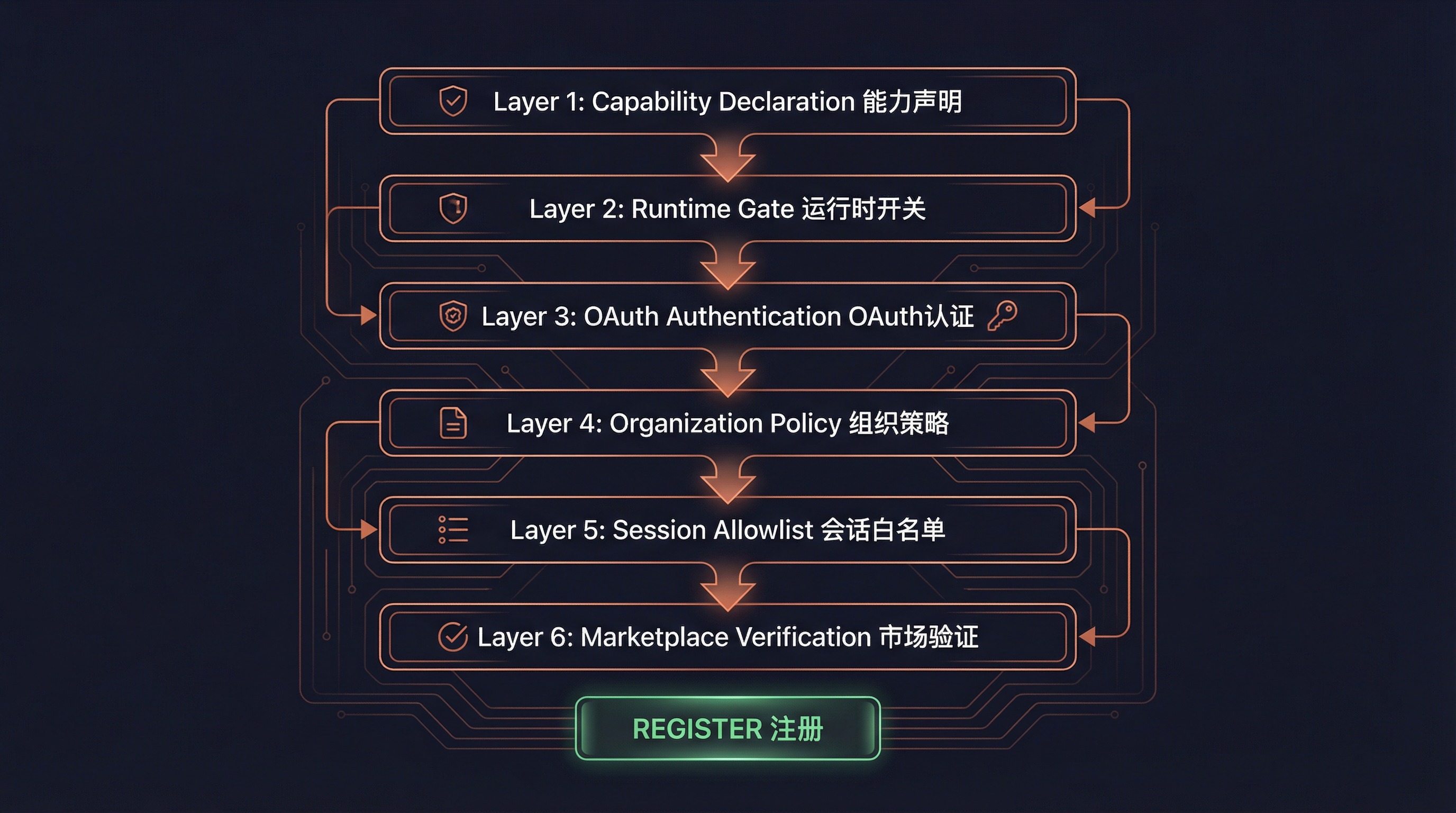
Channel 系统采用六层递进式访问控制,每一层都可以独立阻断 Channel 注册。这是整个系统安全性的基石。
Gate 函数签名
// channelNotification.ts:191-316
function gateChannelServer(
  serverName: string,
  capabilities: ServerCapabilities | undefined,
  pluginSource: string | undefined,
): ChannelGateResult  // { action: 'register' } | { action: 'skip', kind, reason }
4.1 第一层:能力声明(Capability)
if (!capabilities?.experimental?.['claude/channel']) {
  return { action: 'skip', kind: 'capability',
    reason: 'server did not declare claude/channel capability' }
}
MCP Server 必须在握手时声明 experimental['claude/channel']: {} 能力。这是 MCP 的"存在信号"惯例(类似 tools: {}),将普通 MCP Server 与 Channel Server 区分开来。
4.2 第二层:运行时开关(Runtime Gate)
if (!isChannelsEnabled()) {
  return { action: 'skip', kind: 'disabled',
    reason: 'channels feature is not currently available' }
}
isChannelsEnabled() 检查 GrowthBook 特性开关 tengu_harbor(默认 false,5 分钟刷新)。这是全局的"紧急制动"——关闭此开关立即禁用所有 Channel,不需要发版。
4.3 第三层:OAuth 认证(Auth)
if (!getClaudeAIOAuthTokens()?.accessToken) {
  return { action: 'skip', kind: 'auth',
    reason: 'channels requires claude.ai authentication (run /login)' }
}
Channel 仅限 OAuth 认证用户。API Key 用户被阻止,因为 Console 端目前还没有 channelsEnabled 的管理界面。
4.4 第四层:组织策略(Policy)
const sub = getSubscriptionType()
const managed = sub === 'team' || sub === 'enterprise'
const policy = managed ? getSettingsForSource('policySettings') : undefined
if (managed && policy?.channelsEnabled !== true) {
  return { action: 'skip', kind: 'policy',
    reason: 'channels not enabled by org policy' }
}
Teams/Enterprise 组织必须在托管设置中显式启用 channelsEnabled: true。默认关闭——即使没有配置任何策略的团队组织也不会回退到非托管路径。
4.5 第五层:会话白名单(Session)
const entry = findChannelEntry(serverName, getAllowedChannels())
if (!entry) {
  return { action: 'skip', kind: 'session',
    reason: `server ${serverName} not in --channels list for this session` }
}
MCP Server 必须在本次会话的 --channels 参数列表中。即使一个受信任的 Server 动态添加了 claude/channel 能力,也无法绕过——必须用户在启动时显式列出。
4.6 第六层:Marketplace 验证 + 白名单(Allowlist)
对于 plugin 类型的 Channel:
// Marketplace 验证:确保安装的插件来自声称的市场
const actual = pluginSource
  ? parsePluginIdentifier(pluginSource).marketplace
  : undefined
if (actual !== entry.marketplace) {
  return { action: 'skip', kind: 'marketplace',
    reason: `tag mismatch: asked for @${entry.marketplace}, installed from ${actual}` }
}

// 白名单检查:插件必须在 GrowthBook 审批列表中
if (!entry.dev) {
  const { entries } = getEffectiveChannelAllowlist(sub, policy?.allowedChannelPlugins)
  if (!entries.some(e => e.plugin === entry.name && e.marketplace === entry.marketplace)) {
    return { action: 'skip', kind: 'allowlist', reason: 'not on approved list' }
  }
}双重验证:先验证 --channels plugin:slack@anthropic 中的 @anthropic 标签与实际安装的插件来源是否匹配(防止 slack@evil 冒充 slack@anthropic),再检查是否在审批白名单中。
白名单来源优先级:Team/Enterprise 组织可以设置 allowedChannelPlugins,此时它替代 GrowthBook ledger 白名单(管理员拥有信任决策权)。
对于 server 类型,白名单始终失败(schema 是 {marketplace, plugin} 格式,server 类型无法匹配),除非使用 --dangerously-load-development-channels(设置 entry.dev = true 旁路白名单)。
Gate 结果类型
type ChannelGateResult =
  | { action: 'register' }           // 通过所有检查,注册通知处理器
  | { action: 'skip'; kind: string; reason: string }  // 某层拦截

// kind 枚举:capability | disabled | auth | policy | session | marketplace | allowlist
五、权限中继系统
5.1 为什么需要权限中继
当 Claude Code 需要执行敏感操作(如运行 Bash 命令),会弹出权限确认对话框。但如果用户通过 Telegram 远程控制 Agent,他看不到本地终端的对话框。
权限中继系统解决了这个问题:将权限提示转发到 IM 平台,让用户在手机上也能审批或拒绝操作。
5.2 出站:CC → Channel(权限请求)
当 Agent 触发权限对话框且 Channel 声明了 experimental['claude/channel/permission'] 能力时:
// 通知 Schema
const CHANNEL_PERMISSION_REQUEST_METHOD =
  'notifications/claude/channel/permission_request'

type ChannelPermissionRequestParams = {
  request_id: string      // 5 字母标识符(如 "tbxkq")
  tool_name: string       // 工具名(如 "Bash")
  description: string     // 人类可读描述
  input_preview: string   // JSON 输入预览,截断到 200 字符
}
Channel Server 收到后,按各平台格式化(Telegram markdown、Discord embed 等)发送给用户。
5.3 Short Request ID 生成
5 字母标识符的设计充满巧思:
// channelPermissions.ts:140-152
function shortRequestId(toolUseID: string): string {
  let candidate = hashToId(toolUseID)
  for (let salt = 0; salt < 10; salt++) {
    if (!ID_AVOID_SUBSTRINGS.some(bad => candidate.includes(bad))) {
      return candidate
    }
    candidate = hashToId(`${toolUseID}:${salt}`)
  }
  return candidate
}设计决策:
- 25 字母表:a-z 去掉
l(与 1/I 混淆),25^5 约 980 万种组合 - FNV-1a 哈希:不是加密级别,但足够稳定且快速
- 脏话过滤:5 个随机字母可能拼出不雅词汇(如发短信给老板的场景),内置屏蔽词表
- 纯字母:手机用户不需要切换键盘模式(十六进制需要在字母和数字间切换)
- 大小写不敏感:适配手机自动更正
5.4 入站:Channel → CC(权限响应)
用户在 IM 中回复格式:yes tbxkq 或 no tbxkq
// 服务端解析正则
const PERMISSION_REPLY_RE = /^\s*(y|yes|n|no)\s+([a-km-z]{5})\s*$/i

// 结构化通知(服务端解析后发出,而非 CC 端正则匹配文本)
const ChannelPermissionNotificationSchema = z.object({
  method: z.literal('notifications/claude/channel/permission'),
  params: z.object({
    request_id: z.string(),
    behavior: z.enum(['allow', 'deny']),
  }),
})关键设计:Channel Server 负责解析用户回复并发出结构化事件,CC 端不做文本正则匹配。这意味着普通聊天中的文字永远不会意外触发权限审批。
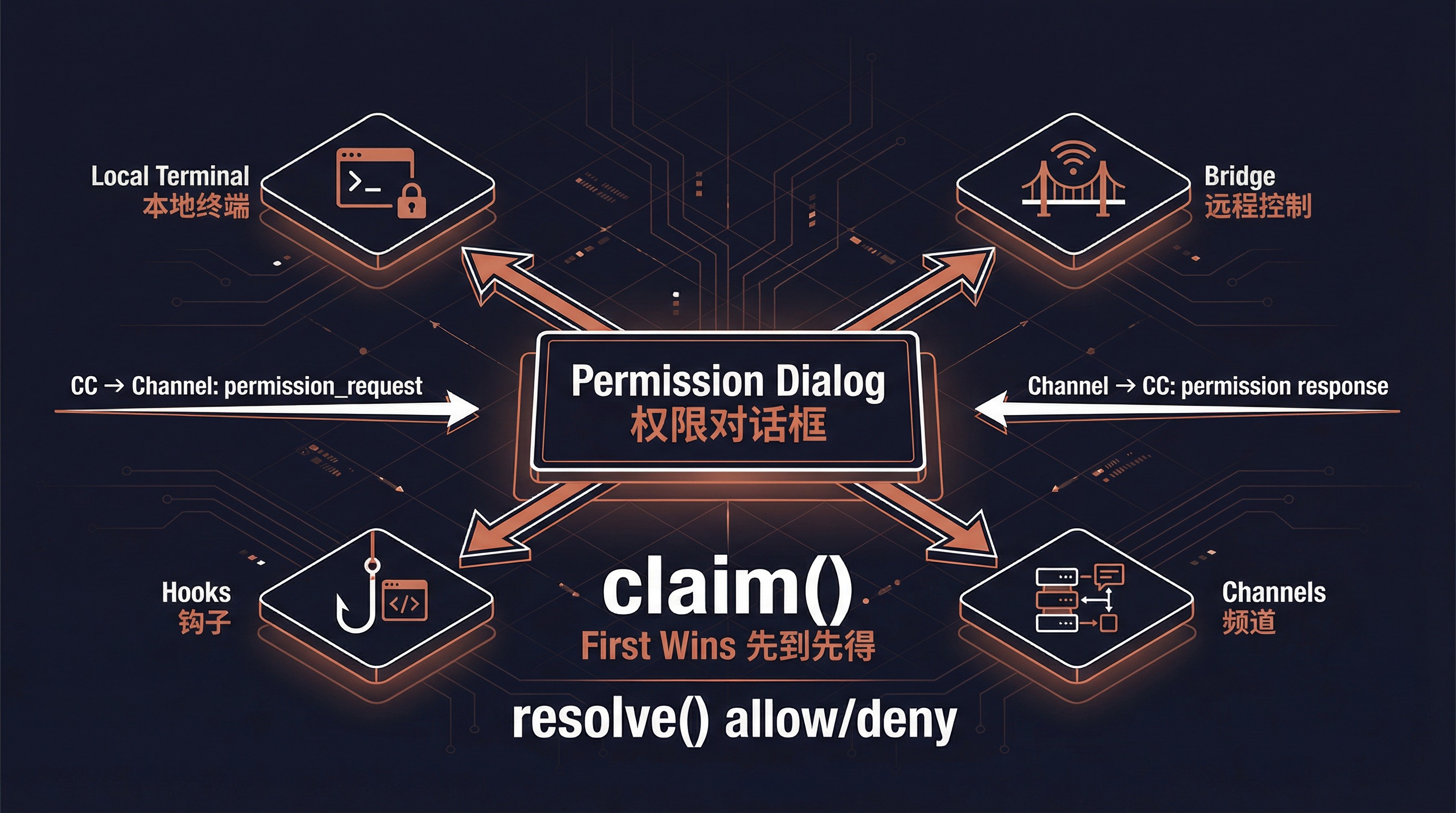
5.5 多源竞争
权限响应来自四个来源,先到先得:
┌──────────────┐   ┌──────────────┐   ┌──────────────┐   ┌──────────────┐
│   本地终端    │   │    Bridge    │   │   Channels   │   │    Hooks     │
│  Local UI    │   │   远程控制    │   │ Telegram etc │   │  Permission  │
└──────┬───────┘   └──────┬───────┘   └──────┬───────┘   └──────┬───────┘
       │                   │                   │                  │
       └───────────────────┴───────────────────┴──────────────────┘
                                    │
                              claim() — 先到先得
                                    │
                              ┌─────┴─────┐
                              │  resolve   │
                              │  allow/deny│
                              └───────────┘
createChannelPermissionCallbacks() 使用闭包维护 pending Map(不在模块级别,也不在 AppState 中——函数引用在状态中会导致序列化问题),构造一次后存入 AppState。
5.6 过滤权限中继客户端
// channelPermissions.ts:177-194
function filterPermissionRelayClients(clients, isInAllowlist) {
  return clients.filter(c =>
    c.type === 'connected' &&
    isInAllowlist(c.name) &&
    c.capabilities?.experimental?.['claude/channel'] !== undefined &&
    c.capabilities?.experimental?.['claude/channel/permission'] !== undefined
  )
}三个条件全部必须:已连接 + 在白名单中 + 同时声明了两个能力(claude/channel 和 claude/channel/permission)。第二个能力是显式 opt-in——只推消息的 Channel 永远不会意外成为权限审批入口。
六、UI 组件
6.1 终端消息渲染(UserChannelMessage)
// UserChannelMessage.tsx
// 解析 <channel> XML 标签并在终端中渲染

const CHANNEL_RE = new RegExp(
  `<${CHANNEL_TAG}\\s+source="([^"]+)"([^>]*)>\\n?([\\s\\S]*?)\\n?</${CHANNEL_TAG}>`
)

// 插件服务器名称显示:plugin:slack-channel:slack → slack
function displayServerName(name: string): string {
  const i = name.lastIndexOf(':')
  return i === -1 ? name : name.slice(i + 1)
}

const TRUNCATE_AT = 60 // 消息体截断长度渲染效果:
◁ tg · alice: 帮我看看 main.ts 有什么问题其中 ◁ 是 Channel 箭头符号(CHANNEL_ARROW),显示服务器叶子名称和可选的用户名。
6.2 状态通知(ChannelsNotice)
启动时显示 --channels 条目的状态,报告阻断原因:
| 阻断类型 | 含义 |
|---|---|
disabled | Channel 功能未启用(tengu_harbor 关闭) |
noAuth | 未通过 OAuth 认证 |
policyBlocked | 组织策略未启用 channels |
unmatched | 未在 --channels 列表中匹配到 |
6.3 开发者确认对话框(DevChannelsDialog)
使用 --dangerously-load-development-channels 时显示的警告对话框:
┌─ WARNING: Loading development channels ──────────────────┐
│                                                          │
│  --dangerously-load-development-channels is for local    │
│  channel development only. Do not use this option to     │
│  run channels you have downloaded off the internet.      │
│                                                          │
│  Please use --channels to run a list of approved channels│
│                                                          │
│  Channels: plugin:my-channel@local                       │
│                                                          │
│  > I am using this for local development                 │
│    Exit                                                  │
└──────────────────────────────────────────────────────────┘
选择 "Exit" 会调用 gracefulShutdownSync(1) 立即退出。
七、插件 Channel 架构
7.1 Plugin Manifest 中的 Channel 声明
插件通过 plugin.json 中的 channels 数组声明 Channel:
// schemas.ts:670-703
const PluginManifestChannelsSchema = z.object({
  channels: z.array(z.object({
    server: z.string().min(1),       // MCP 服务器名,必须匹配 mcpServers 中的 key
    displayName: z.string().optional(),  // 配置对话框标题(如 "Telegram")
    userConfig: z.record(             // 安装时提示用户配置的字段
      z.string(),
      PluginUserConfigOptionSchema()
    ).optional(),
  }).strict()),
})
示例 plugin.json:
{
  "name": "telegram",
  "version": "1.0.0",
  "mcpServers": {
    "tg": {
      "command": "node",
      "args": ["./server.js"],
      "env": {
        "BOT_TOKEN": "${user_config.bot_token}",
        "OWNER_ID": "${user_config.owner_id}"
      }
    }
  },
  "channels": [
    {
      "server": "tg",
      "displayName": "Telegram",
      "userConfig": {
        "bot_token": {
          "type": "string",
          "description": "Telegram Bot API Token",
          "required": true,
          "secret": true
        },
        "owner_id": {
          "type": "string",
          "description": "Your Telegram User ID",
          "required": true
        }
      }
    }
  ]
}
7.2 配置流(PluginOptionsFlow)
启用插件后,如果 Channel 有未配置的 userConfig 字段:
getUnconfiguredChannels()检测未满足验证的字段PluginOptionsFlow组件逐个提示用户输入- 敏感值(如 bot_token)存入 Keychain
- 普通值存入
~/.claude/plugins/options/{pluginId}.json
// mcpPluginIntegration.ts:290-318
function getUnconfiguredChannels(plugin: LoadedPlugin): UnconfiguredChannel[] {
  const channels = plugin.manifest.channels
  if (!channels || channels.length === 0) return []

  const unconfigured: UnconfiguredChannel[] = []
  for (const channel of channels) {
    if (!channel.userConfig) continue
    const saved = loadMcpServerUserConfig(pluginId, channel.server) ?? {}
    const validation = validateUserConfig(saved, channel.userConfig)
    if (!validation.valid) {
      unconfigured.push({
        server: channel.server,
        displayName: channel.displayName ?? channel.server,
        configSchema: channel.userConfig,
      })
    }
  }
  return unconfigured
}
7.3 作用域命名(Scoped Naming)
插件提供的 MCP Server 会被添加作用域前缀以避免冲突:
// mcpPluginIntegration.ts:341-360
function addPluginScopeToServers(
  servers: Record<string, McpServerConfig>,
  pluginName: string,
  pluginSource: string,  // e.g., "telegram@anthropic"
): Record<string, ScopedMcpServerConfig> {
  const scopedServers = {}
  for (const [name, config] of Object.entries(servers)) {
    const scopedName = `plugin:${pluginName}:${name}`
    scopedServers[scopedName] = {
      ...config,
      scope: 'dynamic',
      pluginSource,
    }
  }
  return scopedServers
}命名转换:
- 输入:
{ "tg": { ... } }fromtelegram@anthropic - 输出:
{ "plugin:telegram:tg": { scope: 'dynamic', pluginSource: 'telegram@anthropic', ... } }
pluginSource 被保存在配置上,后续 Channel Gate 的 marketplace 验证步骤会用到它。
7.4 白名单有效来源
// channelNotification.ts:127-138
function getEffectiveChannelAllowlist(sub, orgList) {
  // Team/Enterprise 组织自定义白名单 → 替代 GrowthBook ledger
  if ((sub === 'team' || sub === 'enterprise') && orgList) {
    return { entries: orgList, source: 'org' }
  }
  // 默认使用 GrowthBook ledger
  return { entries: getChannelAllowlist(), source: 'ledger' }
}
组织管理员可以通过 allowedChannelPlugins 完全控制哪些 Channel 插件被信任,而不依赖全局 ledger。
八、安全设计
8.1 XML 注入防护
Channel 消息中的元数据会成为 XML 属性。两道防线:
- 键名过滤:
SAFE_META_KEY = /^[a-zA-Z_][a-zA-Z0-9_]*$/只允许纯标识符 - 值转义:
escapeXmlAttr()对属性值进行 XML 转义
8.2 Marketplace 验证
--channels plugin:slack@anthropic 只是用户的"意图声明"。运行时名称 plugin:slack:X 可能来自 slack@anthropic 或 slack@evil。Gate 验证两者必须匹配:
const actual = pluginSource
  ? parsePluginIdentifier(pluginSource).marketplace
  : undefined
if (actual !== entry.marketplace) {
  return { action: 'skip', kind: 'marketplace', reason: '...' }
}
8.3 权限中继的信任边界
来自代码注释中 Kenneth 的分析(PR 讨论 #2956440848):
"Claude 会自我审批吗?" 答:审批方是通过 Channel 的人类,不是 Claude。但信任边界不是终端——而是白名单(tengu_harbor_ledger)。一个被妥协的 Channel Server 可以在人类没看到提示的情况下伪造 "yes <id>"。这是被接受的风险:一个已妥协的 Channel 本来就有无限的对话注入轮次(可以社会工程攻击、等待 acceptEdits 模式等);注入后自动审批更快,但能力上并不更强。权限对话框减缓了已妥协 Channel 的攻击速度,但不能完全阻止。
8.4 skipSlashCommands
Channel 消息入队时设置 skipSlashCommands: true,确保 IM 用户发送的 /help 等文本不会被解释为 Claude Code 的斜杠命令。
8.5 dev 旁路的粒度
--dangerously-load-development-channels 的 dev 标记是每个条目级别的,不是全局的。接受开发对话框后,只有显式标记为 dev 的条目才旁路白名单,--channels 中的正常条目仍然需要通过完整的白名单检查。
九、命令行接口
9.1 启动参数
# 使用已审批的 Channel 插件
claude --channels plugin:telegram@anthropic plugin:feishu@anthropic

# 本地开发模式(旁路白名单)
claude --dangerously-load-development-channels plugin:my-channel@local

# 两者可以同时使用
claude --channels plugin:telegram@anthropic \
       --dangerously-load-development-channels plugin:dev-channel@local
9.2 参数解析
// main.tsx
const parseChannelEntries = (raw: string[], flag: string): ChannelEntry[] => {
  // 解析 "plugin:slack@anthropic"、"server:slack" 等格式
  // 验证格式正确性
  // 返回 ChannelEntry 数组
}

// 存入全局状态
setAllowedChannels(channelEntries)
9.3 特性门控
这两个 CLI 选项只在特性开关启用时可用:
// main.tsx:3850-3852
if (feature('KAIROS') || feature('KAIROS_CHANNELS')) {
  program.addOption(new Option('--channels <servers...>', '...').hideHelp())
  program.addOption(new Option('--dangerously-load-development-channels <servers...>', '...').hideHelp())
}
hideHelp() 表示这些选项不会出现在 --help 输出中——Channel 功能目前处于隐藏特性阶段。
十、特性开关与分析
10.1 特性开关
| 开关 | 来源 | 用途 |
|---|---|---|
KAIROS / KAIROS_CHANNELS | 编译时 | 控制 CLI 参数注册和代码路径 |
tengu_harbor | GrowthBook 运行时 | Channel 功能总开关(默认 false) |
tengu_harbor_ledger | GrowthBook 运行时 | 审批插件白名单 |
tengu_harbor_permissions | GrowthBook 运行时 | 权限中继功能开关 |
10.2 分析事件
// Channel Gate 结果
tengu_mcp_channel_gate: {
  gate_kind: 'disabled' | 'auth' | 'policy' | 'session' | 'marketplace' | 'allowlist'
  plugin: string
  is_dev: boolean
}

// Channel 消息
tengu_mcp_channel_message: {
  content_length: number
  meta_key_count: number
  entry_kind: 'plugin' | 'server'
  is_dev: boolean
  plugin: string
}

// 启动标志
tengu_mcp_channel_flags: {
  channels_count: number
  dev_count: number
  plugins: string[]
  dev_plugins: string[]
}
十一、总结
Channel 系统是 Claude Code 的 IM 集成框架,它的设计体现了几个核心原则:
1. 安全优先
六层访问控制门确保只有经过审批、用户明确选择的 Channel 才能推送消息。从编译时特性开关到运行时白名单,每一层都可以独立中断。
2. 协议驱动
Channel 不是特殊代码——它们就是普通的 MCP Server,只是多了一个通知协议。这意味着任何能实现 MCP 的语言都可以编写 Channel 插件。
3. 松耦合
Channel 失败不会阻断本地工作流。权限中继是多源竞争机制,任一来源的响应都有效。
4. 渐进式信任
从全局开关 → 认证 → 组织策略 → 会话白名单 → Marketplace 验证 → 白名单,信任级别逐级递增,每一步都有明确的安全目的。
5. 插件友好
通过 plugin.json 的声明式 Channel 配置、自动的用户配置提示流和作用域命名,第三方开发者可以轻松构建自己的 Channel 插件。
源码文件索引
| 文件 | 行数 | 职责 |
|---|---|---|
src/services/mcp/channelNotification.ts | ~320 | 门控、消息封装、白名单集成 |
src/services/mcp/channelPermissions.ts | ~240 | 权限中继、请求 ID 生成 |
src/services/mcp/channelAllowlist.ts | ~80 | GrowthBook 白名单查询 |
src/services/mcp/useManageMCPConnections.ts | - | 连接管理、通知处理器注册 |
src/components/messages/UserChannelMessage.tsx | ~140 | 终端渲染 Channel 消息 |
src/components/DevChannelsDialog.tsx | ~105 | 开发模式确认对话框 |
src/components/LogoV2/ChannelsNotice.tsx | - | 启动时状态通知 |
src/utils/plugins/mcpPluginIntegration.ts | - | 插件 MCP 集成、作用域命名 |
src/utils/plugins/schemas.ts | ~700 | 插件清单 Schema(含 Channel 声明) |
src/bootstrap/state.ts | - | 全局 Channel 白名单状态 |
src/main.tsx | ~3850 | CLI 参数注册和解析 |